
 I always worry about hard drives crashing and losing my photos. It has happened to me more that once. Recovery is expensive, if the files can be recovered. I have had a travel hard drive fail and the recovery was about $1,200.00. I had a RAID hard drive system that failed. The estimated cost for recovery was $10,000.00. The disk drives crashed against each other causing damage that make the files unrecoverable. I lost 5 years of photography with that one. I begged the drive to work, I talked nice to it, I swore at it, I drank over it, and nothing brought it back. On my RAID system, the backup is all in the same unit so the crash also affected the back up drives. It was a very painful lesson. I chose a different system moving forward.
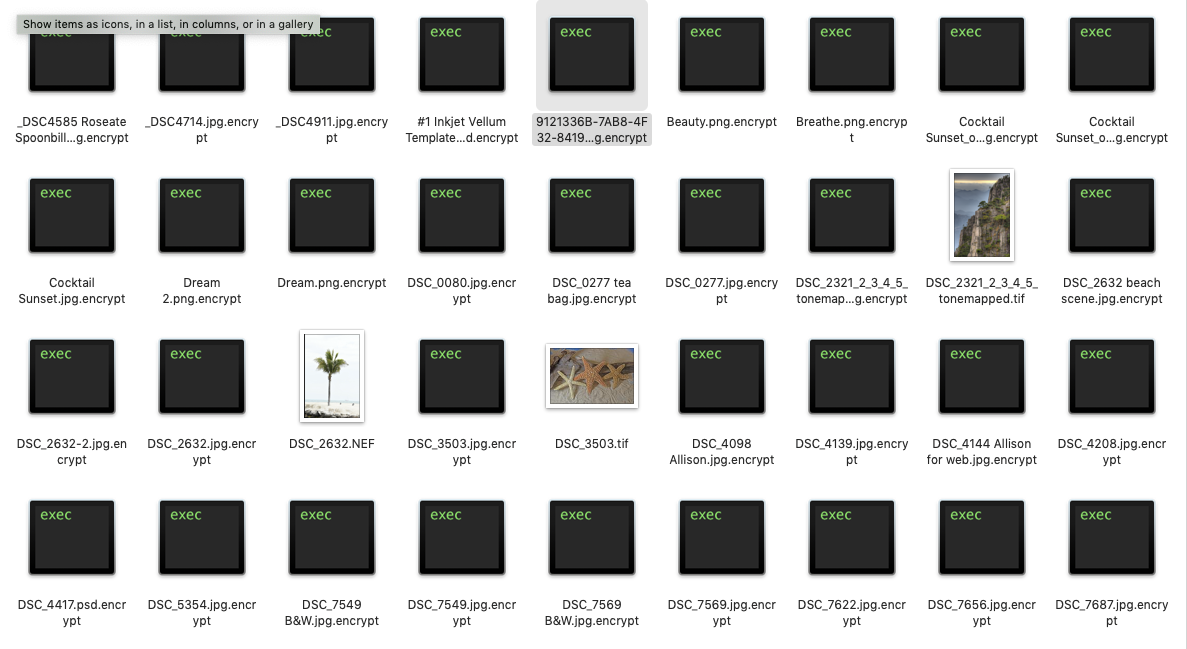
I never thought a cyber attack would happen to me. I am a small time photographer, with a small business. No big corporation, no sensitive files that would cause world problems, no secrets to steal. How could this really be happening? I split my time between two homes and live more at my Florida place than my Michigan home. This made a perfect situation for having my back up files and originals in two separate locations. This is always a good idea in case of a fire or a major power serge that could take out both the original hard drive and the back up hard drive. I use a NAS system. I have 8 hard drives mounted into a large case, and each hard drive is 8 terabytes. That’s a lot of storage and a lot of files! Both homes have identical units and they write to each other through an internet connection. It has worked wonderfully giving me peace of mind that I should be covered if one of the units crashes. While sitting at my dest working on some emails, I noticed that my hard drive was humming away, lights flashing, indicating it was hard at work. Then it occurred to me that I was not working on any files on the hard drive. What was happening? I opened the drive and noticed immediately that I had photos that were no longer visible. They were black and the extension at the end of the file name was .encrypt. I knew something was wrong and shut down the drive. I called technical support for my system and they instructed me to shut it down (I already had) and said I had a virus. I am very much into efficiency so my drives were set up to automatically write to the back up drive in real time. That now meant that the files were being encrypted on the back up drive, as well. A ransom note was left in every effected folder: All your data has been locked(crypted). How to unlock(decrypt) instruction located in this TOR website: http:veqlxhq7ub5qze3qy56zx2cig2e6tzsgxdspkubwbayqije6oatma6id.onion/order/19VouJNEASrQfu1soJjtPdSzrnhQWXN62z Use TOR browser for access .onion websites. https://duckduckgo.com/html?q=tor+browser+how+to Now isn’t that special!?! What the …… well you get the message. I was calling them some very nasty names now. Google had plenty of information for me. This was a Russian Cyber Attacker that has targeted the Synology brand of back up systems. My hard drive is a sophisticated and reliable system that many large businesses use. The attackers remotely went in with a bot and threw thousands of passwords at the system, trying to get in and they succeeded. There is no known key to un-encrypt this virus. Of course, the Cyber attackers can do it for a fee. The going rate is about $850.00 in bitcoin. Bitcoin money is used more in the underground economy, then the markets are used everyday. It is a digital currency that you can buy, then pay it from my digital wallet to another digital wallet through the internet. I can buy my files back from the attackers that stole them. I refuse to do that for many reasons. How do I know that they will even give me the information to unlock my own files? Nope, not playing that game! I am a MAC user and this ended up helping me. I have a ton of files and this went to my favor as well, by taking longer to get through all my files. However, had I not been sitting at my computer when the attack happened I would have had no idea that this was was happening and would have destroyed all my files. I was able to catch it very early, keeping the damage to a minimul. All my word files were encrypted, but I tend to do most of my work in Apple’s version of word which is pages. Those files were not touched. JPEG files were also targeted and I did lose a fair number of those, however all the RAW files were not affected, leaving me my originals. I have about 40 hours of reprocessing work but I still have my photographs. I also lost all my pdf files. The big question is, how am I going to keep this from happening again? I have increased my firewall protection, at the risk of slowing down my internet. Inconvenient, but necessary. I will use stronger passwords and change them quarterly. My hard drives have administrator accounts attached to them and those have been disabled. I have set up protections to lock down the system if there are more than three attempts to get into my system. I am also going to invest into my own server to use as a third back up. I will have one of my hard drive units attached to it and will have it set to automatically back up once a week, without using the internet to access it. Again, inconvenient and costly but necessary. This could be accomplished using another hard drive device but storage is an issue for me and it is more cost effective to go with a server. Cyber attackers keep ahead of the game and will be the new terrorism. Staying ahead of the game will demand us to be diligent. Protecting our art and our family memories should not be this complicated. Unfortunately, there is always going to be people who look to steal, and profit from our loss. Keep your files secure and protected. Most importantly, keep photographing! Create from your heart and your soul, making the world a beautiful place.
I was a guest on my friend,Peggy Ferren's, Understand Photography Web Cast talking about the "Tips & Tricks of Underwater Photography." You can watch it here on uTube'
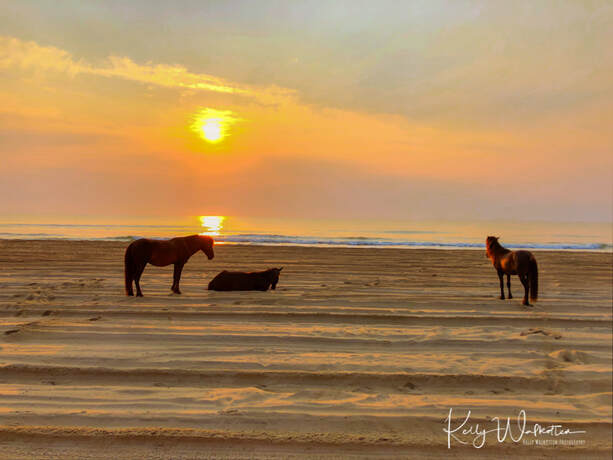 I went to the Outer Banks of North Carolina. I have seen many beautiful pictures of the wild horse herds on the beach. I needed a photograph of my own. I envisioned the photograph to have the beautiful horses running along the shoreline, manes and tails blowing as they ran. I did not have a preference to whether it was a herd running on the beach or just a few, or maybe just one, but I knew I wanted them running along the shoreline, blue skies and the beautiful blue of the ocean.
I got up long before sunrise, about 4:30am. We drove the jeep up and down looking for my shot. I waited and waited and waited. Not one horse by the shore. Not one horse running. Many horses eating the sea oats on the dunes. Looking ahead, finally, horses on the beach! We drove up closer to the horses. There were three of them, two standing and one lying down in the sand. To my amazement, they were watching the sunrise. I stopped the jeep behind them to see what they were seeing. It was beautiful! The sun was rising and it cast a beautiful yellow, orange, and gold color across the sky, spilling onto the sea and the beach. The sun reflecting on the water, the horses silhouetted by the rising sun. They were mesmerized by the scene in front of them, not noticing me at all. The horses appreciating what was before them, a new day, a beautiful sunrise, and I was too busy looking for what I had wanted to see and not seeing what was transpiring right in front of me. The horses never did run on the beach that morning. I stayed until noon. At first I was disappointed because I did not get my “shot” of the running horses, the shot I envisioned. Then it dawned on me (pun intended). I was given a beautiful scene, a beautiful sunrise, most have ever enjoyed. My photo was stunning, interactive, and captured the beauty of the moment. I need to relax a bit, and not let my desires, or my expectations, get in the way of what I am given. I need to appreciate what is happening around me, not getting distracted with my own preconceived ideas. I was given a uniquely beautiful scene, as well as a special moment in time, with the horses watching nature unfold. I do not need to return for another attempt at the running horses. The scene I captured was better than anything I had envisioned. All is well with my soul.  It has happened again. One of my workshop attendees traveled across the US, settled into the classroom portion of my workshop, to discover that the portable hard drive with all her photographs on it had failed. FAILED! Mistake two was made as she had not “gotten around” to backing it up. I could relate. I have had a few hard drive failures in my photography career as well so I could relate to her feeling of despair. In plain english……It Sucks!
I have just found a new product by SanDisk called the Extreme Portable USB 3.1 Type-C External SSD. It is a compact, pocket-sized drive much like a flash drive but on steroids. It is ready for immediate plug-and-play use and is compatible with both Windows and Mac. No special drivers are needed and it does not need to be reformatted. Private files can be password protected if desired. Included with the device is a USB Type-C to Type-C cable and a USB Type-C to Type-A adapter. I was attracted to this for a couple of reasons. The drive is small and compact making it easy to travel with. With a high-speed storage capacity of up to 1TB for high‐res photos, videos, and sound files, the SanDisk Extreme Portable SSD is well-suited for all your creative pursuits or general file storage, making it perfect for photo trips. The devise is also available in a 2T drive. With read speeds of up to 550 MB/s, the SanDisk Extreme Portable SSD lets you offload files very quickly. Extreme Portable USB 3.1 Type-C External SSD is a hardy and durable drive, and not sensitive to movement, dropping, and general field usage, like a portable hard drive. With an IP55 rating, it also stands up to rain, splashes, spills and dust. The durability of the SanDisk Extreme® Portable SSD makes it perfect for all your creative photography pursuits. Here is the technical information regarding the Extreme Portable USB 3.1 Type-C External SSD: Designed for saving and editing high-resolution photos and videos, the 1TB Extreme Portable USB 3.1 Type-C External SSD from SanDisk provides users with up to 1TB of storage for their creative content work, as well as a 10 Gb/s USB 3.1 Type-C interface, which is also known as USB 3.1 Gen 2 and delivers read speeds of up to 550 MB/s. Additionally, this SSD is IP-55 rated and features resistance against water, dust, and shock. It can withstand a water flow of up to 30 kPA for 3 minutes, 1500 g of shock, and 5 gRMS of vibration @ 10-2000 Hz. It can also withstand drops of up to 6.5' on a concrete floor and temperature extremes, with operating temperatures ranging from 32 to 113°F and storage temperatures ranging from -4 to 158°F. Compact and pocket-sized, SanDisk has pre-formatted this SSD as exFAT, meaning it is ready for immediate plug-and-play use with both Windows 10, 8.1 and 7, plus macOS High Sierra, Sierra, and El Capitan without the need for any special drivers or reformatting. Thanks to SanDisk SecureAccess 128-bit AES encryption, private files can be password-protected. Included is a USB Type-C to Type-C cable and a USB Type-C to Type-A adapter. Protection is provided by a limited 3-year warranty. I have purchased two of these SSD drives. One will be used for back-up. There is also a cute case that can be purchased separately to hold the drive and the cords into and has a lanyard to attach it directly to my camera bag. My primary use has been positive. The file transfers are fast and I loved that there was no set-up required. I am looking forward to taking it on my future boat trip around the Bahama Islands (yes boat, water, etc) and a fall trip to the Canadian Rocky Mountains. If you are looking for reliable photo storage I would consider the SanDisk Extreme Portable USB 3.1 Type-C External SSD for yourself. You can find them at my favorite Photo store and supplier Hunt’s Photo & Video www.huntsphotoandvideo.com. They will ship directly to your door. Ready to finish that photography off? I will show you how to make a boarder or frame in photoshop to complete the photograph. Have you ever looked at your photograph and wished you would have composed it differently? I will show you how th use the crop took for a better composition. Unwanted objects in your otherwise great photograph. Learn how to remove them the easy way with the content aware fill tool in photoshop. Have you ever been to that perfect place for sunset and then the clouds move in making your perfect shot a bust? I will show you how to create beautiful sunsets in Lightroom.
Tips for photographing people, architecture and scenery in India and Nepal. What to pack, how to approach people, what to wear and more from Kelly Walkotten and Peggy Farren on The Understand Photography Show, Episode 85. Travel photography is about the journey to me. I like the people, cultures, and ways of life in places far different then my own life. Peggy Farren has a weekly pod cast show titled "Understand Photography." She invited me on her show to talk about travel photography and my recent trip to India and Nepal. You can watch the interview here. I highly recommend you subscribing to her weekly show on Youtube.
Peggy Farren is an award winning, professional photographer, author, instructor and speaker. She’s been interviewed and featured on TV and in many national and local publications. She is the host of The Understand Photography Show which features prominent travel, fine art and nature photographers. The show broadcasts on Facebook, Youtube and as a Podcast at 4 pm ET every Friday. Understand Photography provides photography lessons and tours to photographers who prefer step by step, easy to understand instructions. Our mission and our motto is: “We Simplify the Technical” Photography is more fun when you know what you are doing. If you prefer simplified training without all the technical jargon, you’ve come to the right place! Students can learn at their own pace, at our photography studio in Naples, Florida, on location or in the privacy of their own home via online classes. Join us Fridays at 4 pm ET for The Understand Photography Show using Facebook LIVE! When posting photos on the internet , it is a good idea to protect those images from theft by adding your copyright onto the photograph. I will show you how to create a copyright brush that you can use on all of your photographs.
|